|
| ||||||||||||||||||||||

 | ||||||||||||||||||||||
| November 5, 2004 | | ADVERTISE | ABOUT US | FEEDBACK | | |||||||||||||||||||||
|
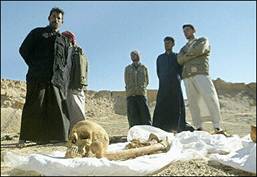
US failed to secure key evidence against Saddam By: Mohamed Ali WASHINGTON, D.C.: A major US human rights group says that Pentagon planners failed to protect potential evidence of massive human rights abuses by the government of ousted President Saddam - official documents and mass graves holding the remains of hundreds of thousands of victims. In a 41-page report released Thursday, Human Rights Watch (HRW) warned that crucial evidence that could be used in upcoming trials of Saddam and his top aides has apparently been lost or damaged. The report, “Iraq: The State of the Evidence,” charged that coalition forces failed to stop people stealing thousands of official documents in the months after the March 2003 invasion. They also failed to stop people from damaging some of the more than 270 mass graves in their search for the remains of relatives. The 270 mass graves could be the key to a successful prosecution of Saddam, but bodies have been dug up at only one site in the year and a half at Hatra from where bodies of little children and even unborn babies were founded since he was toppled. Executive director of the Middle East and North Africa division of the group Sarah Leah Whitson said: “Coalition forces subsequently failed to put in place the professional expertise and assistance necessary to ensure proper classification and exhumation procedures.” “Given what's at stake here, the extent of this negligence is alarming,” said Whitson. “The US and Iraqi authorities were aware that these documents and remains would be crucial to the prosecution of Saddam and other former officials, but they did little to safeguard them.” Still, “it is not too late to assume custody of millions of additional pieces of evidence (that) may prove critical in the proceedings of the upcoming trials.” The report said. Saddam has been accused of ordering the killing of hundreds of thousands of Shias and Kurds. Worries about security at the grave sites, lack of resources and direction from the Iraqi government have contributed to the slow progress. Also, Europeans with expertise in exhumations generally are not helping because of their aversion to the death penalty, a legal punishment in Iraq that Saddam could well face. One group expected to play a key role in the exhumations is the International Commission for Missing Persons, which has had extensive experience in identifying remains of Bosnian war crime victims. The commission is putting together an international conference on helping Iraqis deal with a similar problem. Iraqi officials invited to the conference will be expected to provide guidance on how they want to proceed. Another of the few groups with expertise on humanitarian exhumations is the Boston-based Physicians for Human Rights. “The challenge is to develop in a careful but hopefully expeditious way a plan for all of Iraq that would involve the various stakeholders, including Iraqi government, religious leaders and representatives of families of the missing,” said Susannah Sirkin, the deputy director of the doctors' group. Sirkin says ideally outside groups prepared to help would bow out as Iraqis develop their own expertise in unearthing and identifying the hundreds of thousands of Saddam-era victims. She says the process could take decades. END |
| ||||||||||||||||||||