|
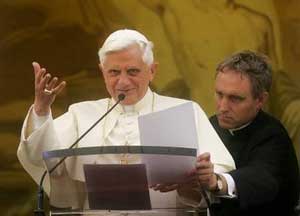
Full text of pontiff’s speech at University of Regensburg
By: Narjes Agha
BERLIN, Germany: Following is the full text of Pope
Benedict XVI's outrageous speech at the University of
Regensburg on September 12 in which he referred Islam to
religious violence:
Distinguished Ladies and Gentlemen,
It is a moving experience for me to stand and give a lecture
at this university podium once again. I think back to those
years when, after a pleasant period at the Freisinger
Hochschule, I began teaching at the University of Bonn. This
was in 1959, in the days of the old university made up of
ordinary professors. The various chairs had neither assistants
nor secretaries, but in recompense there was much direct
contact with students and in particular among the professors
themselves.
We would meet before and after lessons in the rooms of the
teaching staff. There was a lively exchange with historians,
philosophers, philologists and, naturally, between the two
theological faculties. Once a semester there was a dies
academicus, when professors from every faculty appeared before
the students of the entire university, making possible a
genuine experience of universitas: the reality that despite
our specializations which at times make it difficult to
communicate with each other, we made up a whole, working in
everything on the basis of a single rationality with its
various aspects and sharing responsibility for the right use
of reason– this reality became a lived experience.
The university was also very proud of its two theological
faculties. It was clear that, by inquiring about the
reasonableness of faith, they too carried out a work which is
necessarily part of the whole of the universitas scientiarum,
even if not everyone could share the faith which theologians
seek to correlate with reason as a whole. This profound sense
of coherence within the universe of reason was not troubled,
even when it was once reported that a colleague had said there
was something odd about our university: it had two faculties
devoted to something that did not exist: God. That even in the
face of such radical skepticism it is still necessary and
reasonable to raise the question of God through the use of
reason, and to do so in the context of the tradition of the
Christian faith: this, within the university as a whole, was
accepted without question.
I was reminded of all this recently, when I read the edition
by Professor Theodore Khoury (Münster) of part of the dialogue
carried on– perhaps in 1391 in the winter barracks near
Ankara– by the erudite Byzantine emperor Manuel II Paleologus
and an educated Persian on the subject of Christianity and
Islam, and the truth of both. It was probably the emperor
himself who set down this dialogue, during the siege of
Constantinople between 1394 and 1402; and this would explain
why his arguments are given in greater detail than the
responses of the learned Persian.
The dialogue ranges widely over the structures of faith
contained in the Bible and in the Qur’an, and deals especially
with the image of God and of man, while necessarily returning
repeatedly to the relationship of the three Laws: the Old
Testament, the New Testament, and the Qur’an. In this lecture
I would like to discuss only one point– itself rather marginal
to the dialogue itself– which, in the context of the issue of
faith and reason, I found interesting and which can serve as
the starting-point for my reflections on this issue.
In the seventh conversation edited by Professor Khoury, the
emperor touches on the theme of the jihad (holy war). The
emperor must have known that surah 2, 256 reads: There is no
compulsion in religion. It is one of the suras of the early
period, when Mohammed was still powerless and under threat.
But naturally the emperor also knew the instructions,
developed later and recorded in the Qur’an, concerning holy
war. Without descending to details, such as the difference in
treatment accorded to those who have the “Book” and the
“infidels,” he turns to his interlocutor somewhat brusquely
with the central question on the relationship between religion
and violence in general, in these words:
Show me just what Mohammed brought that was new, and there you
will find things only evil and inhuman, such as his command to
spread by the sword the faith he preached.
The emperor goes on to explain in detail the reasons why
spreading the faith through violence is something
unreasonable. Violence is incompatible with the nature of God
and the nature of the soul.
God is not pleased by blood, and not acting reasonably is
contrary to God’s nature. Faith is born of the soul, not the
body. Whoever would lead someone to faith needs the ability to
speak well and to reason properly, without violence and
threats… To convince a reasonable soul, one does not need a
strong arm, or weapons of any kind, or any other means of
threatening a person with death….
The decisive statement in this argument against violent
conversion is this: not to act in accordance with reason is
contrary to God’s nature. The editor, Theodore Khoury,
observes: “For the emperor, as a Byzantine shaped by Greek
philosophy, this statement is self-evident. But for Muslim
teaching, God is absolutely transcendent. His will is not
bound up with any of our categories, even that of
rationality.” Here Khoury quotes a work of the noted French
Islamist R. Arnaldez, who points out that Ibn Hazn went so far
as to state that God is not bound even by his own word, and
that nothing would oblige him to reveal the truth to us. Were
it God’s will, we would even have to practice idolatry.
As far as understanding of God and thus the concrete practice
of religion is concerned, we find ourselves faced with a
dilemma which nowadays challenges us directly. Is the
conviction that acting unreasonably contradicts God’s nature
merely a Greek idea, or is it always and intrinsically true? I
believe that here we can see the profound harmony between what
is Greek in the best sense of the word and the biblical
understanding of faith in God. Modifying the first verse of
the Book of Genesis, John began the prologue of his Gospel
with the words: In the beginning was the logos. This is the
very word used by the emperor: God acts with logos.
Logos means both reason and word– a reason which is creative
and capable of self-communication, precisely as reason. John
thus spoke the final word on the biblical concept of God, and
in this word all the often toilsome and tortuous threads of
biblical faith find their culmination and synthesis. In the
beginning was the logos, and the logos is God, says the
Evangelist.
The encounter between the Biblical message and Greek thought
did not happen by chance. The vision of Saint Paul, who saw
the roads to Asia barred and in a dream saw a Macedonian man
plead with him: Come over to Macedonia and help us! (cf. Acts
16:6-10)– this vision can be interpreted as a distillation of
the intrinsic necessity of a rapprochement between Biblical
faith and Greek inquiry.
In point of fact, this rapprochement had been going on for
some time. The mysterious name of God, revealed from the
burning bush, a name which separates this God from all other
divinities with their many names and declares simply that he
is, is already presents a challenge to the notion of myth, to
which Socrates’s attempt to vanquish and transcend myth stands
in close analogy. Within the Old Testament, the process which
started at the burning bush came to new maturity at the time
of the Exile, when the God of Israel, an Israel now deprived
of its land and worship, was proclaimed as the God of heaven
and earth and described in a simple formula which echoes the
words uttered at the burning bush: I am.
This new understanding of God is accompanied by a kind of
enlightenment, which finds stark expression in the mockery of
gods who are merely the work of human hands (cf. Ps 115).
Thus, despite the bitter conflict with those Hellenistic
rulers who sought to accommodate it forcibly to the customs
and idolatrous cult of the Greeks, biblical faith, in the
Hellenistic period, encountered the best of Greek thought at a
deep level, resulting in a mutual enrichment evident
especially in the later wisdom literature.
Today we know that the Greek translation of the Old Testament
produced at Alexandria– the Septuagint– is more than a simple
(and in that sense perhaps less than satisfactory) translation
of the Hebrew text: it is an independent textual witness and a
distinct and important step in the history of revelation, one
which brought about this encounter in a way that was decisive
for the birth and spread of Christianity. A profound encounter
of faith and reason is taking place here, an encounter between
genuine enlightenment and religion. From the very heart of
Christian faith and, at the same time, the heart of Greek
thought now joined to faith, Manuel II was able to say: Not to
act “with logos” is contrary to God’s nature.
In all honesty, one must observe that in the late Middle Ages
we find trends in theology which would sunder this synthesis
between the Greek spirit and the Christian spirit. In contrast
with the so-called intellectualism of Augustine and Thomas,
there arose with Duns Scotus a voluntarism which ultimately
led to the claim that we can only know God’s voluntas ordinata.
Beyond this is the realm of God’s freedom, in virtue of which
he could have done the opposite of everything he has actually
done. This gives rise to positions which clearly approach
those of Ibn Hazn and might even lead to the image of a
capricious God, who is not even bound to truth and goodness.
God’s transcendence and otherness are so exalted that our
reason, our sense of the true and good, are no longer an
authentic mirror of God, whose deepest possibilities remain
eternally unattainable and hidden behind his actual decisions.
As opposed to this, the faith of the Church has always
insisted that between God and us, between his eternal Creator
Spirit and our created reason there exists a real analogy, in
which unlikeness remains infinitely greater than likeness, yet
not to the point of abolishing analogy and its language (cf.
Lateran IV). God does not become more divine when we push him
away from us in a sheer, impenetrable voluntarism; rather, the
truly divine God is the God who has revealed himself as logos
and, as logos, has acted and continues to act lovingly on our
behalf. Certainly, love transcends knowledge and is thereby
capable of perceiving more than thought alone (cf. Eph 3:19);
nonetheless it continues to be love of the God who is logos.
Consequently, Christian worship is worship in harmony with the
eternal Word and with our reason (cf. Rom 12:1).
This inner rapprochement between Biblical faith and Greek
philosophical inquiry was an event of decisive importance not
only from the standpoint of the history of religions, but also
from that of world history-– it is an event which concerns us
even today. Given this convergence, it is not surprising that
Christianity, despite its origins and some significant
developments in the East, finally took on its historically
decisive character in Europe. We can also express this the
other way around: this convergence, with the subsequent
addition of the Roman heritage, created Europe and remains the
foundation of what can rightly be called Europe.
The thesis that the critically purified Greek heritage forms
an integral part of Christian faith has been countered by the
call for a dehellenization of Christianity-– a call which has
more and more dominated theological discussions since the
beginning of the modern age. Viewed more closely, three stages
can be observed in the program of dehellenization: although
interconnected, they are clearly distinct from one another in
their motivations and objectives.
Dehellenization first emerges in connection with the
fundamental postulates of the Reformation in the 16th century.
Looking at the tradition of scholastic theology, the Reformers
thought they were confronted with a faith system totally
conditioned by philosophy, that is to say an articulation of
the faith based on an alien system of thought. As a result,
faith no longer appeared as a living historical Word but as
one element of an overarching philosophical system. The
principle of sola scriptura, on the other hand, sought faith
in its pure, primordial form, as originally found in the
biblical Word. Metaphysics appeared as a premise derived from
another source, from which faith had to be liberated in order
to become once more fully itself. When Kant stated that he
needed to set thinking aside in order to make room for faith,
he carried this program forward with a radicalism that the
Reformers could never have foreseen. He thus anchored faith
exclusively in practical reason, denying it access to reality
as a whole.
The liberal theology of the 19th and 20th centuries ushered in
a second stage in the process of dehellenization, with Adolf
von Harnack as its outstanding representative. When I was a
student, and in the early years of my teaching, this program
was highly influential in Catholic theology too. It took as
its point of departure Pascal’s distinction between the God of
the philosophers and the God of Abraham, Isaac, and Jacob.
In my inaugural lecture at Bonn in 1959, I tried to address
the issue. I will not repeat here what I said on that
occasion, but I would like to describe at least briefly what
was new about this second stage of dehellenization. Harnack’s
central idea was to return simply to the man Jesus and to his
simple message, underneath the accretions of theology and
indeed of hellenization: this simple message was seen as the
culmination of the religious development of humanity. Jesus
was said to have put an end to worship in favor of morality.
In the end he was presented as the father of a humanitarian
moral message. The fundamental goal was to bring Christianity
back into harmony with modern reason, liberating it, that is
to say, from seemingly philosophical and theological elements,
such as faith in Christ’s divinity and the triune God.
In this sense, historical-critical exegesis of the New
Testament restored to theology its place within the
university: theology, for Harnack, is something essentially
historical and therefore strictly scientific. What it is able
to say critically about Jesus is, so to speak, an expression
of practical reason and consequently it can take its rightful
place within the university. Behind this thinking lies the
modern self-limitation of reason, classically expressed in
Kant’s “Critiques”, but in the meantime further radicalized by
the impact of the natural sciences. This modern concept of
reason is based, to put it briefly, on a synthesis between
Platonism (Cartesianism) and empiricism, a synthesis confirmed
by the success of technology. On the one hand it presupposes
the mathematical structure of matter, its intrinsic
rationality, which makes it possible to understand how matter
works and use it efficiently: this basic premise is, so to
speak, the Platonic element in the modern understanding of
nature. On the other hand, there is nature’s capacity to be
exploited for our purposes, and here only the possibility of
verification or falsification through experimentation can
yield ultimate certainty. The weight between the two poles
can, depending on the circumstances, shift from one side to
the other. As strongly positivistic a thinker as J. Monod has
declared himself a convinced Platonist/Cartesian.
This gives rise to two principles which are crucial for the
issue we have raised. First, only the kind of certainty
resulting from the interplay of mathematical and empirical
elements can be considered scientific. Anything that would
claim to be science must be measured against this criterion.
Hence the human sciences, such as history, psychology,
sociology, and philosophy, attempt to conform themselves to
this canon of scientificity. A second point, which is
important for our reflections, is that by its very nature this
method excludes the question of God, making it appear an
unscientific or pre-scientific question. Consequently, we are
faced with a reduction of the radius of science and reason,
one which needs to be questioned.
We shall return to this problem later. In the meantime, it
must be observed that from this standpoint any attempt to
maintain theology’s claim to be “scientific” would end up
reducing Christianity to a mere fragment of its former self.
But we must say more: it is man himself who ends up being
reduced, for the specifically human questions about our origin
and destiny, the questions raised by religion and ethics, then
have no place within the purview of collective reason as
defined by “science” and must thus be relegated to the realm
of the subjective. The subject then decides, on the basis of
his experiences, what he considers tenable in matters of
religion, and the subjective “conscience” becomes the sole
arbiter of what is ethical. In this way, though, ethics and
religion lose their power to create a community and become a
completely personal matter.
This is a dangerous state of affairs for humanity, as we see
from the disturbing pathologies of religion and reason which
necessarily erupt when reason is so reduced that questions of
religion and ethics no longer concern it. Attempts to
construct an ethic from the rules of evolution or from
psychology and sociology, end up being simply inadequate.
Before I draw the conclusions to which all this has been
leading, I must briefly refer to the third stage of
dehellenization, which is now in progress. In the light of our
experience with cultural pluralism, it is often said nowadays
that the synthesis with Hellenism achieved in the early Church
was a preliminary enculturation which ought not to be binding
on other cultures. The latter are said to have the right to
return to the simple message of the New Testament prior to
that enculturation, in order to inculturate it anew in their
own particular milieux. This thesis is not only false; it is
coarse and lacking in precision. The New Testament was written
in Greek and bears the imprint of the Greek spirit, which had
already come to maturity as the Old Testament developed. True,
there are elements in the evolution of the early Church which
do not have to be integrated into all cultures. Nonetheless,
the fundamental decisions made about the relationship between
faith and the use of human reason are part of the faith
itself; they are developments consonant with the nature of
faith itself.
And so I come to my conclusion. This attempt, painted with
broad strokes, at a critique of modern reason from within has
nothing to do with putting the clock back to the time before
the Enlightenment and rejecting the insights of the modern
age. The positive aspects of modernity are to be acknowledged
unreservedly: we are all grateful for the marvelous
possibilities that it has opened up for mankind and for the
progress in humanity that has been granted to us. The
scientific ethos, moreover, is the will to be obedient to the
truth, and, as such, it embodies an attitude which reflects
one of the basic tenets of Christianity. The intention here is
not one of retrenchment or negative criticism, but of
broadening our concept of reason and its application.
While we rejoice in the new possibilities open to humanity, we
also see the dangers arising from these possibilities and we
must ask ourselves how we can overcome them. We will succeed
in doing so only if reason and faith come together in a new
way, if we overcome the self-imposed limitation of reason to
the empirically verifiable, and if we once more disclose its
vast horizons. In this sense theology rightly belongs in the
university and within the wide-ranging dialogue of sciences,
not merely as a historical discipline and one of the human
sciences, but precisely as theology, as inquiry into the
rationality of faith.
Only thus do we become capable of that genuine dialogue of
cultures and religions so urgently needed today. In the
Western world it is widely held that only positivistic reason
and the forms of philosophy based on it are universally valid.
Yet the world’s profoundly religious cultures see this
exclusion of the divine from the universality of reason as an
attack on their most profound convictions. A reason which is
deaf to the divine and which relegates religion into the realm
of subcultures is incapable of entering into the dialogue of
cultures. At the same time, as I have attempted to show,
modern scientific reason with its intrinsically Platonic
element bears within itself a question which points beyond
itself and beyond the possibilities of its methodology.
Modern scientific reason quite simply has to accept the
rational structure of matter and the correspondence between
our spirit and the prevailing rational structures of nature as
a given, on which its methodology has to be based. Yet the
question why this has to be so is a real question, and one
which has to be remanded by the natural sciences to other
modes and planes of thought: to philosophy and theology.
For philosophy and, albeit in a different way, for theology,
listening to the great experiences and insights of the
religious traditions of humanity, and those of the Christian
faith in particular, is a source of knowledge, and to ignore
it would be an unacceptable restriction of our listening and
responding. Here I am reminded of something Socrates said to
Phaedo. In their earlier conversations, many false
philosophical opinions had been raised, and so Socrates says:
“It would be easily understandable if someone became so
annoyed at all these false notions that for the rest of his
life he despised and mocked all talk about being - but in this
way he would be deprived of the truth of existence and would
suffer a great loss”.
The West has long been endangered by this aversion to the
questions which underlie its rationality, and can only suffer
great harm thereby. The courage to engage the whole breadth of
reason, and not the denial of its grandeur – this is the
program with which a theology grounded in Biblical faith
enters into the debates of our time. “Not to act reasonably
(with logos) is contrary to the nature of God”, said Manuel
II, according to his Christian understanding of God, in
response to his Persian interlocutor. It is to this great
logos, to this breadth of reason, that we invite our partners
in the dialogue of cultures. To rediscover it constantly is
the great task of the university.
|
|
 |
| |
"Knowledge is
better than wealth because it protects you while you have to
guard wealth. it decreases if you keep on spending it but the
more you make use of knowledge ,the more it increases . what you
get through wealth disappears as soon as wealth disappears but
what you achieve through knowledge will remain even after you."MORE
..

|
|
|
|
|
|
|