|
US gives ‘Green Light to Oppress Shiites’: Report
Sender: Rannie Amiri
LONDON, United Kingdom: British newspaper The Guardian
has accused the United States of America in one of its reports that it
has given ‘green light for oppression’ in the Middle East.
The Guardian report is as under:
http://commentisfree.guardian.co.uk/brian_whitaker
/2007/07/a_green_light_to_oppression.html
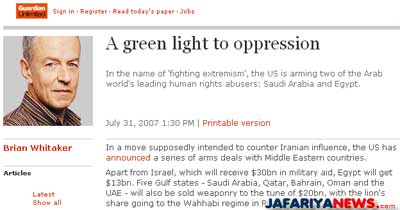
A green light to oppression
guardian.co.uk/commentisfree > Brian Whitaker
July 31, 2007
In the name of 'fighting extremism', the US is arming two of the Arab
world's leading human rights abusers: Saudi Arabia and Egypt.
In a move supposedly intended to counter Iranian influence, the US has
announced a series of arms deals with Middle Eastern countries.
Apart from Israel, which will receive $30bn in military aid, Egypt
will get $13bn. Five Gulf states - Saudi Arabia, Qatar, Bahrain, Oman
and the UAE - will also be sold weaponry to the tune of $20bn, with
the lion's share going to the Wahhabi regime in Riyadh.
Thus, in the name of "working with these states to fight back
extremism" (as secretary of state Condoleezza Rice put it), the US is
arming two of the Arab world's leading human rights abusers: Saudi
Arabia and Egypt.
The reaction from Tehran was predictable. US policy "is creating fear
and concerns in the countries of the region and trying to harm the
good relations between these countries", foreign ministry spokesman
Mohammad Ali Hosseini told reporters in Tehran. And he's absolutely
right.
If the Bush administration's goal was to inflame Sunni-Shia tensions
across the region and to spread the sectarian strife in Iraq to
neighbouring countries, it would be hard to imagine a more effective
way of going about it.
Although Iran is the worldwide centre of Shia Islam, there's an
important distinction to be made between Shia Muslims and the Iranian
regime. The question is how many people will actually make it.
Marginalized Shia communities in the Gulf States and Egypt will
undoubtedly feel more threatened, while others will interpret the
American move as a green light to oppress them further.
In Egypt, the tiny Shia population is already harassed by the
authorities and treated with suspicion. Some of this has been
documented by the Egyptian Initiative for Personal Rights. Its report
talks of Shia Muslims being arrested - ostensibly for security reasons
- but then being subjected to torrents of abuse by state security
officers for their religious beliefs.
One officer is quoted as telling a suspect: "I'm going to keep tabs on
you. If you try anything, I'll make you regret it. I'm prepared to
forgive the members of the Gamaa'a Islamiyya [the armed Sunni Islamist
group], although they murder us, but I wouldn't forgive you, because
at least the Gamaa'a Islamiyya shares my creed."
In Saudi Arabia, where Shia account for 20% of the population (and,
more critically, 75% in the oil-rich region), the official policy, as
Matthew Mainen of the Institute for Gulf Affairs noted recently, is to
treat them as polytheists, idol worshippers, and as part of a vast
Jewish conspiracy against Islam.
"Matching the indoctrination of Saudi Arabia's public education
system, governmental practices and policies reinforce the notion that
Shia Muslims are subhuman. Shia books, education, music, and art are
banned in Saudi Arabia. Shias are further barred from playing any
political, social, or religious role in Saudi society, and are not
even allowed to provide testimony in courts of law ...
"As long as Saudi Arabia continues to promote and practise an ideology
holding that it is the obligation of Sunni Muslims to purge Islam of
Shias in the great jihad, hundreds of Saudi insurgents will continue
to cross the Iraqi border to further the sectarian violence without
hindrance from the Saudi security forces."
As the US state department itself has observed in a report on
religious freedom in the kingdom:
"Members of the Shia minority are subject to officially sanctioned
political and economic discrimination ...
"Members of the Shia minority are discriminated against in government
employment, especially in national security-related positions, such as
in the military or Ministry of Interior. While there are some Shia who
occupy high-level positions in government-owned companies and
government agencies, many Shia believe that openly identifying
themselves as Shia would have a negative impact on career advancement
... While there is no formal policy concerning the hiring and
promotion of Shia, anecdotal evidence suggests that in some companies
-including companies in the oil and petrochemical industries -
well-qualified Shia are passed over for less-qualified Sunni
compatriots ...
"The Government also discriminates against Shia in higher education
through unofficial restrictions on the number of Shia admitted to
universities."
Viewed from Washington, bolstering tyrannical Sunni regimes against
Iran might seem like pragmatism - a convergence of interests. But it's
a dangerous sort of pragmatism because the American and Saudi
interests are ultimately different. The Saudi government isn't really
worried about Tehran; it's worried about keeping the lid on its Shia
population in the oil-rich eastern province - and in the long term
that can only rebound negatively on the US.
Just as there is a need to recognise that Jews in general are not
responsible for the actions of the Israeli government, nor ordinary
Muslims for the actions of al-Qaida, Arab states must be careful not
to automatically treat their Shia communities as tools of the Iranian
government, or encourage the public to think that they are.
What the region needs most right now is not more arms but a concerted
effort to promote religious tolerance, to combat religious
discrimination and prejudice, and to draw the Arab Shia communities
into the political processes of their home countries before it is too
late.
|
|
 |
| |
"Knowledge is
better than wealth because it protects you while you have to
guard wealth. it decreases if you keep on spending it but the
more you make use of knowledge ,the more it increases . what you
get through wealth disappears as soon as wealth disappears but
what you achieve through knowledge will remain even after you."MORE
..

|
|
|
|
|
|
|