|
Activities of “Ayyam-e-Hurmat-e-Quran and Rasool” continue in Pakistan
By: Salman Alvi
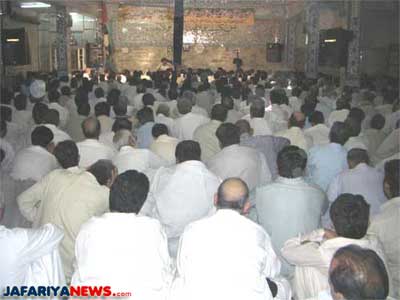
RAWALPINDI, Pakistan: The “Ayyam-e-Hurmat-e-Quran and Rasool”
programmes announced by Quaid-i-Millat-i-Jafariya Agha Syed Hamid Ali
Shah Moosavi continued throughout the country on Sunday May 25.
Majalis, Matamdari and religious functions were held in all small and
big cities and towns of the country including the Federal Capital
Islamabad, all the four provinces, Azad Kashmir and Northern Areas.
The main Majlis-e-Aza in this connection to pay homage to
Nigehban-e-Risalat Hazrat Abu Talib (A.S.) was organised by Syed
Muazzam Ali Rizvi Advocate at Markazi Imambargah Qadeem.
Allama Agha Ali Hussain Najfi in his address on the occasion said
Quran is that great a book that Allah Himself has taken the
responsibility of its protection and no one from the atheist world
could bring any reply to it that is why they remain busy in
desecration of it on one pretext or the other. However, he said such
sacrifices have been rendered for its protection and to ensure its
dignity in the past which are exemplary.
Allama Syed Qamar Haider Zaidi in his address said that almost in
every book of the Islamic history, it has openly been admitted that
the Rasool-e-Khuda (SAAW) not only brought up the Hazoor-e-Akram (SAAW)
but he also enjoys the honour of being his Nikah Khwan.
Allama Nasir Abbas Multan, Maulana Ijaz Hussain Madras, Zakir Sajjad
Hussain Shumari, Zakir Ilyas Raza, Zakir Khuda Bux Qaiser, Zakir Nasir
Abbas Notak, Maulana Malik Ijlal Haider Al-Haideri, Zakir Qazi Wasim
Abbas, Zakir Iqbal Hussain Shah Bajar, Syed Zamir Hussain Kazmi, Zakir
Noor-ul-Hassan Noori and other Zakireen also addressed the gathering.
A resolution presented by Abu Nasam Naqvi was adopted on the occasion
that considered creation of a motherland on the basis of Two-Nation
Theory and that we are residents of this great country. The resolution
expressed concern that our eternal enemy was going all out to
destabilise Pakistan and thus appealed all serious sections of the
government and the opposition to adopt the policy of mutual
understanding so as to thwart the heinous conspiracies of the enemies
of the country and the religion.
Another resolution condemned all blasphemous activities so far
committed and considered it an open challenge for the comity of
nations. The resolution demanded from the United Nations, Security
Council, ICC and champions of human rights the world over to stop the
colonial powers and their agents from committing blasphemous
activities and for that purpose introduce suitable law at
international level so that no one could even think of doing so in
future.
The resolution called upon the powers that be and the politicians to
ensure basic needs of the people instead of entangling them in
political bickering.
Another resolution condemned the gory murders of a TV channel
journalist Muhammad Ibrahim in Bajaur and Muslim League leader Tariq
Khan and considered it a continuation of incidents of terrorism going
on in the country.
The resolution also welcomed the Swat peace agreement. The resolution
said that the Pakistani people had thwarted the Zia tyranny 30 years
ago when it tried to divide the people on sectarian basis. An 8-month
long agitation was launched from the Hussaini Mohaz from this
Imambargah and more than 14,000 Sunni-Shia people courted arrest that
culminated into May 21, 1985 Junejo-Moosavi agreement. The newly
elected government was asked to implement that agreement immediately.
The resolution condemned the so-called scholar Zakir Naik who twice
supported Yazid in a private TV channel Pace’s programme and demanded
from Pemra to impose ban on this TV channel forthwith.
Another function was held at Qasr-e-Abu Talib Mughalabad. Allama
Mohsin Ali Hamdani, Zakir Nawab Arif Dhando, Naveed Ashiq B.A., Qamar
Raza Naqvi, Aqeel Mohsin Naqvi in their address on the occasion
highlighted the seerat of Syed-us-Sajideen (A.S.) and declared the
invaluable services and sacrifices rendered by them as golden chapter
of the Islamic history.
|
|
 |
| |
"Knowledge is
better than wealth because it protects you while you have to
guard wealth. it decreases if you keep on spending it but the
more you make use of knowledge ,the more it increases . what you
get through wealth disappears as soon as wealth disappears but
what you achieve through knowledge will remain even after you."MORE
..

|
|
|
|
|
|
|