|
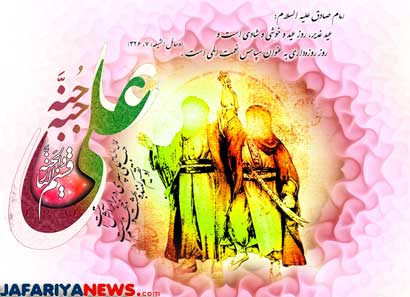
Background of Feast of Ghadir
By: Morteza Kermani
On the 18th of Dhul-Hajjah, after completing his last
pilgrimage (Hajjatul-Widaa), Prophet (p) was leaving Mecca toward
Medina, when he and the crowd of people reached to a place called
Ghadir Khum (which is close to today's Juhfah).
It was a place where people from different provinces should say
Good-bye to each other and take different routes for their home. In
this place, the following verse was revealed:
"O Apostle! Deliver what has been sent down to you from your Lord; and
if you don't do it, you have not delivered His message (at all); and
Allah will protect you from the people ..." (Quran 5:67).
Some of Sunni references confirming that the revelation of the above
verse of Quran was right before the speech of Prophet in Ghadir Khum:
(1) Tafsir al-Kabir, by Fakhr al-Razi, under commentary of verse 5:67,
v12, pp 49-50, narrated on the authorities of Ibn Abbas, al-Bara Ibn
Azib, and Muhammad Ibn Ali.
(2) Asbab al-Nuzool, by al-Wahidi, p50, narrated on the authorities of
Atiyyah and Abu Sa'id al Khudri.
(3) Nuzul al-Quran, by al-Hafiz Abu Nu'aym narrated on the authorities
Abu Sa'id Khudri and Abu Rafi.
(4) al-Fusool al Muhimmah, by Ibn Sabbagh al-Maliki al-Makki, p24
(5) Durr al-Manthur, by al-Hafiz al-Suyuti, under commentary of verse
5:67
(6) Fathul Qadir, by al-Shawkani, under commentary of verse 5:67
(7) Fathul Bayan, by Hasan Khan, under commentary of verse 5:67
(8) Shaykh Muhi al-Din al-Nawawi, under commentary of verse 5:67
(9) al-Sirah al-Halabiyah, by Noor al-Din al-Halabi, v3, p301
(10) Umdatul Qari fi Sharh Sahih al-Bukhari, by al-Ayni
(11) Tafsir al-Nisaboori, v6, p194
(12) and many more such as Ibn Mardawayh, etc...
The last sentence in the above verse indicates that the Prophet
(PBUH&HF) was mindful of the reaction of his people in delivering that
message but Allah informs him not to worry, for He will protect His
Messenger from people.
Upon receiving the verse, the Prophet (PBUH&HF) stopped on that place
(the pond of Khum) which was extremely hot. Then he sent for all
people who have been ahead in the way, to come back and waited until
all pilgrims who fell behind, arrived and gathered. He ordered Salman
(RA) to use rocks and camel toolings to make a pulpit (minbar) so he
could make his announcement. It was around noon time on the first of
the Fall, and due to the extreme heat in that valley, people were
wrapping their robes around their feet and legs, and were sitting
around the pulpit, on the hot rocks.
On this day the Messenger of Allah spent approximately five hours in
this place; three hours of which he was on the pulpit. He recited
nearly one hundred verses from The Glorious Quran, and for seventy
three times reminded and warned people of their deeds and future. Then
he gave them a long speech. The following is a part of his speech
which has been widely narrated by the Sunni traditionists:
The Messenger of Allah declared: "It seems the time has approached
when I shall be called away (by Allah) and I shall answer that call. I
am leaving for you two precious things and if you adhere both of them,
you will never go astray after me. They are the Book of Allah and my
progeny, that is my Ahlul-Bayt. The two shall never separate from each
other until they come to me by the Pool (of Paradise)."
Then the Messenger of Allah continued: "Do I not have more right over
the believers than what they have over themselves?" People cried and
answered: "Yes, O' Messenger of God." Then Prophet (PBUH) held up the
hand of Ali and said: "Whoever I am his master (Mawla), Ali is his
master (Mawla). O' God, love those who love him, and be hostile to
those who are hostile to him."
Some of the aammah references:
1) Sahih Tirmidhi, v2, p298, v5, p63
(2) Sunan Ibn Maja, v1, pp 12,43
(3) Khasa'is, by al-Nisa'i, pp 4,21
(4) al-Mustadrak, by al-Hakim, v2, p129, v3, pp 109-110,116,371
(5) Musnad Ahmad Ibn Hanbal, v1, pp 84,118,119,152,330, v4, pp
281,368,370,
372,378, v5, pp 35,347,358,361,366,419 (from 40 chains of narrators)
(6) Fada'il al-Sahaba, by Ahmad Hanbal, v2, pp 563,572
(7) Majma' al-Zawa'id, by al-Haythami, v9, p103 (from several
transmitters)
(8) Tafsir al-Kabir, by Fakhr al-Razi, v12, pp 49-50
(9) Tafsir al-Durr al-Manthur, by al-Hafiz Jalaluddin al-Suyuti, v3,
p19
(10) Tarikh al-Khulafa, by al-Suyuti, pp 169,173
(11) al-Bidayah wal-Nihayah, by Ibn Kathir, v3, p213, v5, p208
(12) Usdul Ghabah, by Ibn Athir, v4, p114
(13) Mushkil al-Athar, by al-Tahawi, v2, pp 307-308
(14) Habib al-Siyar, by Mir Khand, v1, part 3, p144
(15) Sawaiq al-Muhriqah, by Ibn Hajar al-Haythami, p26
(16) al-Isabah, by Ibn Hajar al-Asqalani, v2, p509; v1, part1, p319,
v2, part1, p57, v3, part1, p29, v4, part 1, pp 14,16,143
(17) Tabarani, who narrated from companions such as Ibn Umar, Malik
Ibn
al-Hawirath, Habashi Ibn Junadah, Jari, Sa'd Ibn Abi Waqqas,
Anas Ibn Malik, Ibn Abbas, Amarah,Buraydah,...
(18) Tarikh, by al-Khatib Baghdadi, v8, p290
(19) Hilyatul Awliya', by al-Hafiz Abu Nu'aym, v4, p23, v5, pp26-27
(20) al-Istiab, by Ibn Abd al-Barr, Chapter of word "ayn" (Ali), v2,
p462
(21) Kanzul Ummal, by al-Muttaqi al-Hindi, v6, pp 154,397
(22) al-Mirqat, v5, p568
(23) al-Riyad al-Nadirah, by al-Muhib al-Tabari, v2, p172
(24) Dhaka'ir al-Uqba, by al-Muhib al-Tabari, p68
(25) Faydh al-Qadir, by al-Manawi, v6, p217
(26) Yanabi' al-Mawaddah, by al-Qudoozi al-Hanafi, p297
... And hundreds more. Please see part 3 for more classified
references
(traditionists, historians, and commentators).
Immediately after Prophet (PBUH&HF) finished his speech, the following
verse of Holy Quran was revealed:
"Today I have perfected your religion and completed my bounty upon
you, and chosen Islam as your religion." (Quran 5:3)
Some of aammah references which mentioned the revelation of the above
verse of Quran in Ghadir Khum after the speech of the Prophet:
(1) al-Durr al-Manthur, by al-Hafiz Jalaluddin al-Suyuti, v3, p19
(2) Tarikh, by Khatib al-Baghdadi, v8, pp 290,596 from Abu Hurayra
(3) Manaqaib, by Ibn Maghazali, p19
(4) History of Damascus, Ibn Asakir, v2, p75
(5) al-Itqan, by al-Suyuti, v1, p13
(6) Manaqib, by Khawarazmi al-Hanfi, p80
(7) al-Bidayah wal-Nihayah, by Ibn Kathir, v3, p213
(8) Yanabi' al-Mawaddah, by al-Qudoozi al-Hanafi, p115
(9) Nuzul al-Quran, by al-Hafiz Abu Nu'aym narrated on the authority
Abu Sa'id Khudri.
... and more.
The above verse clearly indicates that Islam without clearing up the
matter of leadership after Prophet was not completed, and the
completion of religion was
due to announcement of Prophet's immediate successor.
After his speech, the Messenger of Allah asked everybody to give the
oath of allegiance to Ali (AS) and congratulate him. Among those who
gave him the oath were Umar, Abu Bakr, and Uthman. It is narrated that
Umar and Abu Bakr said:
"congratulations Ibn Abi Talib! Today you became the master (Mawla) of
all
believing men and women."
aammah references:
(1) Musnad Ahmad Ibn Hanbal, v4, p281
(2) Tafsir al-Kabir, by Fakhr al-Razi, v12, pp 49-50
(3) Mishkat al-Masabih, by al-Khatib al-Tabrizi, p557
(4) Habib al-Siyar, by Mir Khand, v1, part3, p144
(5) Kitabul Wilayah, by Ibn Jarir al-Tabari
(6) al-Musannaf, by Ibn Abi Shaybah
(7) al-Musnad, by Abu Ya'ala
(8) Hadith al-Wilayah, by Ahmad Ibn `Uqdah
(9) Tarikh, by Khatib al-Baghdadi, v8, pp 290,596 from Abu Hurayra
... and more.
"There were with the Messenger (PBUH) from the companions, Arabs,
residents around Mecca and Medina one hundred and twenty thousand
(120,000) and they were those who were present in the Farewell
Pilgrimage and heard this speech."
Sunni reference: Manaqib, by Ibn al-Jawzi
Some aammah commentators further claimed that the first three verse of
the chapter of al-Ma'arij (70:1-3) was revealed when a dispute arose
after Prophet reached Medina. It is recorded that:
On the day of Ghadir the Messenger of Allah summoned the people toward
Ali and said: "Ali is the MAWLA of whom I am MAWLA." The news spread
quickly all over urban and rural areas. When Harith Ibn Nu'man
al-Fahri (or Nadhr Ibn Harith according to another tradition) came to
know of it, he rode his camel and came to Medina and went to the
Messenger of Allah (PBUH&HP) and said to him: "You commanded us to
testify that there is no deity but Allah and that you are the
Messenger of Allah. We obeyed you. You ordered us to perform the
prayers five times a day and we obeyed. You ordered us to observe
fasts during the month of Ramadhan and we obeyed. Then you commanded
us to offer pilgrimage to Mecca and we obeyed. But you are not
satisfied with all this and you raised your cousin by your hand and
imposed him upon us as our master by saying `Ali is the MAWLA of whom
I am MAWLA.' Is this imposition from Allah or from You?" The Prophet
(PBUH&HP) said: "By Allah who is the only deity! This is from Allah,
the Mighty
and the Glorious."
On hearing this Harith turned back and proceeded towards his she-camel
saying: "O Allah! If what Muhammad said is correct then fling on us a
stone from the sky and subject us to severe pain and torture." He had
not reached his she-camel when Allah, who is above all defects flung
at him a stone which struck him on his head, penetrated his body and
passed out through his lower body and left him dead. It was on this
occasion that Allah, the exalted, caused to descend the following
verses:
"A questioner questioned about the punishment to fall. For the
disbelievers there is nothing to avert it, from Allah the Lord of the
Ascent." (70:1-3)
aammah references:
(1) Tafsir al-Tha'labi, by Is'haq al-Tha'labi, commentary of verse
70:1-3
from two chains of narrators.
(2) Noor al-Absar, by Shablanji, p4
(3) al-Fusool al-Muhimmah, by Ibn Sabbagh al-Maliki al-Makki, p25
(4) al-Sirah al-Halabiyah, by Noor al-Din al-Halabi, v2, p214
(5) Arjah al-Matalib
(6) Nazhat al-Mujalis from al-Qurtubi
|
|
 |
| |
"Knowledge is
better than wealth because it protects you while you have to
guard wealth. it decreases if you keep on spending it but the
more you make use of knowledge ,the more it increases . what you
get through wealth disappears as soon as wealth disappears but
what you achieve through knowledge will remain even after you."MORE
.. |
|
|
|
|
|
|