|
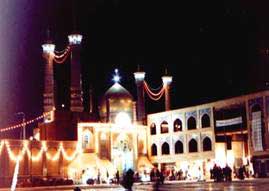
History of the Kadhmayn gold-domed holy shrine
By: Taghrid Al-Aktham
Presenting this write-up on the occasion of birth anniversary of
Imam Muhammad Taqi Al-Jawwad (A.S.) ---
Everyone approaching Iraqi capital city of Baghdad from the north or
the west will be impressed by the sight of the four golden minarets at
Kadhmayn, the Shrine of the Two Imams, Imam Mousa Al-Kadhim (A.S.) and
Imam Muhammad Taqi Al-Jawwad (A.S.), the Seventh and the Ninth of the
Twelve Imams respectively, at whose tombs we are accustomed to seek
healing and to invoke their intercession for the forgiveness of our
sins and the fulfillment of our needs.
The present building dates back only to the beginning of the sixteenth
century and has been kept in excellent repair. This building
represents the restoration of Shah lsmail I Safavi (1502 - 24), though
when the Turkish Sultan, Suleman the Great, captured Baghdad and
remained there for four months in 1534, he visited this sacred place
and is said to have contributed to the further ornamentation of the
Shrine at Kadhmayn.
The tiles for the double cupola, however, were provided in 1796 by
Shah Agha Muhammad Khan, who was the first of the Persian Qajar
dynasty. In 1870, Nasr-ud-Din Shah had these golden tiles repaired on
one of the domes and on the minarets. It is interesting that the dates
of all these alterations are clearly indicated by inscriptions.
If we bear in mind that the Two Imams (A.S.) who are buried here were
martyred in the beginning of the eighth century, it will be evident
that there are seven hundred years of the history of their tomb to
account for, previous to the comparatively modern restoration of Shah
Ismail I.
The Imams lived in the early days of Baghdad, while the walls of
Mansur's round city on the western side of the Tigris were still
standing. There were cemeteries to the north-west that went by various
names - that at the Syrian Gate, that of the Abbasids, and that of the
Straw Gate.
The Two Imams (A.S.) were buried immediately to the west of this
latter cemetery, but by the time Yakubi wrote, the whole northern
district was designated in a general way as the cemetery of the
Kuraish.
As to the importance attached in the early times to the visit to this
tomb, the only information available is on the authority of traditions
that have been attributed to the Eighth and Tenth Imams. These
traditions are answers they are said to have given when they were
asked by their followers concerning the merit of pilgrimage to
Kadhmayn.
It is related that the Imam Ali Redha (A.S.), whose life in Baghdad
was during the caliphate of Haroon-ur-Rashid, told his followers to
say their prayers of salutation to his father, the Imam Mousa Al-Kadhim
(A.S.), "Outside the walls of the Shrine, or in the nearby mosques,"
if the authority and prejudice in Baghdad was too great for them to do
so at the tomb itself. From this we infer that a building of some sort
was recognized at that early date as marking the tomb of the Imam
Mousa Al-Kadhim (A.S.) and that it was surrounded by a wall.
Further statements are said to have been made a few years later by the
Imam Ali Naqi (A.S.), whose period in the Imamat began during the
later part of the Caliphate of Mu'tasim, and who enjoyed greater
indulgence that was shown to the Imam’s followers until the period of
reaction against them and the Mu'tazalites under the Caliph Mutawakkil.
The following particular instructions for visiting this Shrine have
been given by Allamah Al-Majlisi.
When you wish to visit the tomb of Mousa ibn Jafar Al-Kadhim (A.S.)
and the tomb of Muhammad ibn Ali ibn Mousa Al-Jawwad (A.S.), first you
must bathe and make yourself clean, then anoint yourself with perfume
and put on two clean garments, after which you are to say at the tomb
of the Imam Mousa Al-Kadhim (A.S.):
Peace be upon thee, O Friend of God!
Peace be upon thee, O Proof of God!
Peace be upon thee, O Light of God!
O Light in the dark place of the earth!
Peace be upon him whom God advances in thy regard,
Behold I come as a pilgrim, who acknowledges your right,
Who hates your enemies and befriends your friends,
So intercede for me therefore with your Lord.
"You are then free," said the Imam Ali Naqi (A.S.), "to ask for your
personal needs, after which you should offer a prayer in salutation to
the Imam Muhammad Taqi (A.S.), using these same words."
Majlisi, who has included these traditions in his instructions for
modern pilgrims to this Shrine, makes the observation in explanation
of the unusual - brevity of the prescribed prayer, "that it was
necessary in those times to take great care in dissimulation (taqiyah)
that the followers of imam should not suffer injury."
Another tradition that dates from the same century in which these two
Imams died is attributed to a certain Hasan ibn Jamhur, who said:
"In the year 296 A.H., when Ali ibn Ahmad Al-Frat was Vizier, I saw
Ahmad ibn Rabi", who was one of the Caliph's writers, when his hand
had gotten infected so that it had bad odour and turned black.
Everyone who saw him had no doubt but that he would die. In a dream,
however, he saw Imam Ali (A.S.), and said to him: "O Amiru'l Momineen,
will you not ask God to give me my hand?" Ali (A.S.) answered, `go to
Mousa ibn Jafar (A.S.) and he will ask this for you from God.'
In the morning they got a litter and carpeted it, gave him a bath and
anointed him with perfume. They had him lie down in the litter and
covered him with a robe. Then they carried him to the tomb of Imam
Mousa ibn Jafar (A.S.), whose intercession he sought in prayer.
The afflicted man took some of the earth from the tomb and rubbed it
on his arm upto the shoulder and then bound the arm up again. The next
day, when he opened the bandage, he saw that all the skin and flesh of
the arm had fallen off, and that only the bones and veins and
ligaments remained, and the bad odour had also ceased, When the vizier
heard of this he took the men to testify as what had happened. In a
short time the healthy flesh and skin grew back again, and he was able
to resume his work of writing."
Majlisi adds the comment that "in every period there have been so many
miracles (mu'jizaat) and demonstrations of power (karamat) at the tomb
of these two Imams that there is no need to describe cases of the
past. In our own times there are so many instances occurring and
recurring that to recount them would be a lengthy process."
After the Abbasid caliphs had fallen more under the authority of the
commanders of their armies of Turkish mercenaries, there was a rising
of the Buyids (or Buwaihids) in Persia; and in A.D. 946 the Caliph
Mustakfi was blinded by the Buyid Prince, Mu'izzu'd Dawla, who set up
the blinded Caliph's son, Al-Muktaddir, as a nominal ruler while he
exercised the actual authority himself. Ibn Athir has related that
"the Buyids were fanatical adherents of Ali (A.S.) and firmly
convinced that the Abbasids were usurpers of a throne that rightfully
belonged to others."
They did not take over the Caliphate, but in addition to retaining for
themselves the authority and perquisites of the government of the
provinces, they proclaimed the first ten days of the month of Muharram
as a period of public mourning for Husain (A.S.), and they frequently
enriched the sanctuary at Kadhmayn with their gifts. The Caliph Tai'
is reported to have led the Friday prayers in the Kadhmayn mosque, so
that in the period of the revival of the imam’s followers’ influence
under the protection of the Buyids, we are certain that the Kadhmayn
Shrine was regularly visited by pilgrims and served as "the rallying
place of the followers."
It was during this period that the four great works of the Khassah
tradition were compiled. Kulaini died in Baghdad in A.D. 939, after
completing his monumental work, the Compendium of the Science of
Religion (al-Kafi fi Ilm ad-din), which is perhaps the most highly
esteemed of all the Khassah source books. Ibn Babuwaihi had come to
Baghdad from Khorasan in 966 A.D., where he devoted himself to
teaching and writing.
His `Every Man His Own Lawyer' (Kitab man la yah-dhuruhu' l-Faqih), is
also one of the four most authoritative books on Khassah law and
tradition. And sixteen years after the death of Ibn Babuwaihi, Al-Tusi
also came from Khorasan to teach in Baghdad, where he wrote the
remaining two of the four great books of traditions that lie at the
basis of Kjhassah theology and jurisprudence, `The Correcting of
judgments' (Tahzhib al-Ahkam) and the `Examination of Differences in
Traditions' (Al-Istibsar).
In a period of disturbances in 1051 A.D., the Shrine of Kadhmayn was
plundered. After carrying off the gold and silver lamps and the
curtains which adorned these sanctuaries, the rioters on the following
day completed their work by setting fire to the buildings. The great
teak-wood domes above the shrines of the Imam Mousa ibn-Jafar (A.S.)
and Imam Muhammad Taqi (A.S.)were entirely burnt. This fact that the
domes were at first of teak-wood has something to do doubtless with
the number of times they were burned.
It was shortly after the burning of the Shrine in 1051 A.D. that the
Seljuk Sultans displaced the Buwaihids as military dictators in Persia
and "Protectors" of the Caliphs in Baghdad. Nevertheless, when they
came to Baghdad, no injury was done to the Shrine at Kadhmayn. And
when Sultan Malik Shah visited it in 1086, it had apparently been
repaired from the damages of the fire of thirty-five years before.
Ibn Jubayr, who gives a detailed description of Baghdad in 1184, A.D.
in his Travels, mentions the tomb of Imam Mousa ibn Jafar (A.S.), but
he does not speak of it as Kadhmayn, and he makes no reference to the
tomb of the Imam Muhammad Taqi (A.S.).
Notwithstanding, before another hundred years had passed when the
domes of the Shrines had again been destroyed by fire, we find that
its repair was regarded as of sufficient importance to be the one and
only enterprise that the short-lived Caliph Zahir had been able to
undertake.
When the Mongols came with their overwhelming force in 1258, they
wrought almost complete devastation in and around Baghdad. There is
said to have been an understanding, however, that the holy cities
should be spared, and in fact Kadhmayn was the only one of these
shrines that suffered. This was perhaps to the destruction of the
western part of the city first.
It may have been during the subsequent siege of the fortress on the
eastern side of the Tigris that the deputation of Shias from Hilla
arrived and arranged with Khulagu Khan for the special protection of
Najaf and Kerbala. However that may be, we know that the city of
Baghdad was utterly ruined by the Mongols, and that the tombs of
Kadhmayn were burned. "Nearly all the inhabitants, to the number,
according to Rashid ad-Din, of 800,000 (Makrizi says 2,000,000)
perished and thus passed away one of the noblest cities that had ever
graced the East - the Cynocure of the Muhammadan world, where the
luxury, wealth and culture of five centuries had been concentrated...
The booty captured, we are told, was so great that Georgians and
Tartars succumbed under the load of gold and silver, precious stones
and pearls, rich stuffs, gold and silver vessels, etc., while as to
the vases from China and Rashan (i.e., procelain), and those made in
the country of iron and copper, they were deemed scarcely of any
value, and were broken and thrown away. The soldiers were so rich that
the saddles of their horses and mules and their most ordinary utensils
were inlaid with stones, pearls and gold. Some of them broke off their
swords at the hilt and filled up the scabbards with gold, while others
emptied the body of a Baghdadi, refilled it with gold, precious stones
and pearls, and carried it off from the city."
The death of the last of the Abbasid Caliphs, Mustasim, has been so
celebrated in literature that what actually happened is obscure.
There are numerous accounts of how Hulagu Khan was disgusted when he
saw that in his avarice the Caliph had gathered gold which he had been
unwilling to spend either in defense of the city or to effect
favorable terms of capitulation.
Marco Polo relates the story that when Hulagu Khan entered Baghdad he
found to his astonishment a town that was filled with gold and silver,
and in his indignation he gave orders that the avaricious Caliph
should be "shut up in this same town, without sustenance; and there,
in the midst of his wealth, he soon finished a miserable existence."
This story is based on the narrative of Mirkhond, of joinville, and of
Makakia, the Armenian historian, and as Howarth remarks it has
provided "one of those grim episodes which Longfellow delighted to put
into verse":-
I said to the Caliph, "Thou art old,
Thou hast no need of so much gold;
Thou should'st not have heaped and hidden it here,
Till the breath of battle was hot and near,
But have sown through the land these useless hoards,
To spring into shining blades of swords,
And keep thine honour sweet and clear."
Then into his dungeon I locked the drone,
And left him there to feed all alone,
In the honey cells of his golden hive;
Never a prayer, nor a cry, nor a groan,
Was heard from those massive walls of stone,
Nor again was the Caliph seen alive.
One notable fact in this connection is that the life of the Caliph's
vizier in Baghdad was spared. He was Muayid-ud-din Alkamiya who was
reported to have sent his submission to Khulagu, and had invited him
to invade the country. However, this may be, the Caliph was put to
death on the 21st February, 1258. Wassaf and Novairi say he was rolled
up in carpets and, then trodden under by horses so that his blood
should not be spilt. This was in accordance with the `yasa' of Jingis
Khan, which forbade the shedding of the blood of royal persons.
But the Caliph's vizier, whose life was spared, "retained his post as
vizier, the reward doubtless of his dubious loyalty." Various
prominent Persians, as distinguished from Arabs or Turks were
appointed to important positions in the new administration of affairs,
and among the first buildings to be rebuilt was the Shrine of the two
Imams, at Kadhmayn.
After the fall of the last of the Abbasid Caliph, Baghdad was never
rebuilt on its former scale of grandeur. The Il-Khans, Who were the
descendants of Khulagu, held the city for 82 years, not as a capital,
however, but merely as the chief town of the province of Iraq. It was
near the close of their period of authority that the traveler Mustawfi
visited Baghdad (1339) A.D., and at that time he mentioned seeing the
Shrines of Al-Kadhim (A.S.) and of his grandson, Taqi (A.S.), the
seventh and ninth Imams. He observed that Kadhmayn was a suburb by
itself, about six thousand paces in circumberence.
About that time the Mongol tribe of Julayr wrested the power from the
Il-Khans, and their chief, Shaikh Hasan Buzurg, made his residence in
Baghdad in 1340, as the town best suited for his tribal headquarters.
Fifty odd years later, in connection with his widespread conquests,
Timur spent three months in Baghdad. It happened to be in the summer
that he besieged and captured the city, and the Persian chronicler in
the Zafar Nameh remarks that "the heat was so intense, that as for the
fish in the water, the saliva boiled in their mounts: and as for the
birds in the air, from the fever heat their livers were cooked and
they fell senseless."
The horrors of the taking of the city are described in graphic detail.
So thoroughly had all avenue of escape been closed that when the wind
accelerated the flames that filled the air, there were many people who
threw themselves into the water, to escape the fire or sword. It was a
time when the slave market was such that an old man of eighty and a
child of twelve sold for the same price and the fire of hate waxed to
such a heat that the garment of the wealthy merchant and the rags of
the sick beggar burned the same way. Individual soldiers in bands of
the troops had been each commissioned to each get a head, but some who
were not content with one head got all they could tie to their belts.
It is mentioned, however, that some of the men of learning and rank as
were granted his protection and shared his bounty, but the general
carnage was hideous. When the inhabitants had been thus almost
annihilated, their habitations were dealt with. Only the mosques, the
schools, and the dormitories were spared. Accordingly, we read that
Timur left Baghdad on account of "vile odour of the carcases of the
dead."
Nevertheless, when Timur took his departure, we are told that he
ordered that the city should be rebuilt. The shrine at Kadhmayn,
however, was not restored. After the death of Timur, there was a brief
reoccupation of Baghdad by the Julayrs, who were displaced by the
"Black Sheep" Turkomans, who held the city from 1411-1469. They in
turn were driven out by their rivals, the "White Sheep" Turkomans.
It was therefore after a long period of neglect, when the city had
been held by successive generations of half savage tribes, that Shah
Ismail I, of the Safawi dynasty captured Baghdad in 1508, and it was
in 1519 that he completed the rebuilding of the Shrine at Kadhmayn
much as it stands today. With the rise of Shah Ismail there is an
interesting and significant story of the revival of Persian Shia
Power, which belongs in the history of Ardebil in Azerbaijan rather
than in a description of the Shrine of the "Two Kadhims" in Baghdad.
We are told that frequently from twenty-five, to thirty thousand
pilgrims visit the Shrine in one day. If viewed from a point of
vantage, this Shrine with its twin domes of gleaming gold is one of
the most beautiful sights in Baghdad; and if studied in its historical
associations throughout the last eleven hundred years, it affords a
thrilling resume of the changing fortunes of the far-famed city of
Arabian Nights.
Footnotes:
1. Ibn Sa'd, Tabakat, VII, ii, pp. 68, I. 18; 99, I. 21; & 80, I.
II.
2. Yakubi, Tarikh, edit, Houtsma, Vol. 11, P. 499.
3. Kulaini, Usul al-Kafi P. 203.
4. Majlisi, Toafatu's- Za'irin, pp. 308 fi.
5. Majiisi, op. cit., p. 309.
6. Ibn al-Athir, Kamil, viii, p. 177.
7. Browne, Persian Literature in Modern Times, p. 31.
8. Le Strange, Baghdad during the Abbasid Caliphate, p. 162.
9. Le Strange, Op. cit., p. 164.
10. Le Strange, Op. cit., p. 163.
11. Ibn Jubayr, Travels, Wright's text revised by de Goeje, P. 226.
12. lbn Tiktaka, Kitab al- Fakhri, p. 163.
13. Howarth, History of the Mongols, iii, pp. 126, 127.
14. Travels of Marco Polo the Venitian, ch. viii.
15. Howarth, Op. cit. pp. 127-131.
16. Mustawfi, Nuzhatu'l-Qulub, Eng. trans. Gibb Mem. series, vol.
XXIII, ii, p. 42.
17. Zafar Nameh, by Sharifu'd-din Ali Yazdi, edt. Calcutta 1887-8,
vol. II pp. 363-369.
Other References:
Encyclopaedia of Islam, art. "Kadhmayn".
|
|
 |
| |
"Knowledge is
better than wealth because it protects you while you have to
guard wealth. it decreases if you keep on spending it but the
more you make use of knowledge ,the more it increases . what you
get through wealth disappears as soon as wealth disappears but
what you achieve through knowledge will remain even after you."MORE
..

|
|
|
|
|
|
|