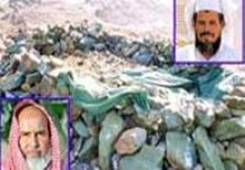
The tomb of Amena Bent Wahb “the prophet’s mother”
On the old Hijra road between Mecca and Medina, on an old famous rocky
hill, it is believed that there is where the tomb of Amena Bent Wahb,
the prophet’s mother, lies.
|
"Followers of the Shiite Jaferi sect are committed
to constantly visiting the village because as well as the importance
of the grave, it is the birthplace of Imam Mousa Al-Kadhem (in the
128th year of Hijra) the grandson of the Prophet’s (PBUH) grandson." |
In the past few years, the old controversy over the reality of the
burial place was revived. The argument was soon ended when a group of
extremists settled it by removing the tomb away from the people and
archaeologists. In the middle of a wide valley, Al-Abwaa’ village (210
km south of Al-Medina) is famous for being the most important stop on
the old road to pilgrimage. This is due to its abundance of water and
plants that satisfy the needs of those performing either the Hajj
pilgrimage or Umrah pilgrimage. The area is now known as 'Al-Khreibah'
which means damaged place, named after the damage caused by violent
floods.
Although it contains many old wells, the most famous is “Bin Mibeirek”
though their waters are now shallow and undrinkable. They are also
surrounded by archaeological rest houses. Folks in Abwaa’ have no
doubt that lady Amena took her last breath somewhere in their ancient
village on her way back from Yathrib (Al-Medina) to Mecca. However
they cannot determine the exact place where she was buried.
Most visitors of Abwaa’, who usually come on religious occasions, are
those on the pilgrimage coming from India, Pakistan, South East Asian
countries, Iran, Egypt and many others. They would visit the resting
place of prophet’s mother due to their customs and traditions loaded
with incenses, musk, small scented wooden sticks, ambergris, and
different types of perfumes to decorate the gravestones. Some are keen
to color the stones in green while others cover the surface of the
grave with folds of green cloth out of respect to the Prophet’s mother
and to seek closeness to her orphan child, the last of prophets (PBUH).
Followers of the Shiite Jaferi sect are committed to constantly
visiting the village because as well as the importance of the grave,
it is the birthplace of Imam Mousa Al-Kadhem (in the 128th year of
Hijra) the grandson of the Prophet’s (PBUH) grandson.
Many of the villagers are outraged, especially the stronger followers
of the religion, by the customs of those visitors and their behavior
in glorifying tombs, an act that is banned in Islam. Their anger
usually causes violence and verbal clashes with those who behave in
this exaggerated way in order to prevent them from any sort of action
that honors tombs. These villagers believe that this is a form of
idolatry and the worship of another besides Allah. All this paved the
way for the removing of the famous tomb. Uncomfortably, Rashed Al-Yubi
(Abu Sa’d) retells stories about the clashing between the visitors and
the persistence of the villagers. The villagers would try to explain
that what these people do at graves deviates from the tradition of the
Prophet (PBUH) and endangers their faith. He said, “They wouldn’t
listen to our advice and honesty of wanting nothing but good for them.
We would feel terrible when those visitors turn their faces away from
us asking, “What kind of hospitality is this?” With remarkable
confidence, Sheikh Salem AL-Mohammady, an elderly chief of Al-Abwaa
village, confirms that the prophet’s mother was buried in Abwaa. But
the famous tomb on top of the hill cannot be related to her. He
justifies by saying, “the tomb lies alone on top of a mountain
contradicting historical and biographical books that mention that her
grave is situated among many others. He added, “What is confirmed is
that as the prophet (PBUH) was passing by Al-Abwaa with a group of his
Sahaba (companions), he passed by various tombs to stop by one of
them, before he told his friends that it was the tomb of his mother
Amena Bent Wahb”.
|
"In his book “This
is Fatimah Al-Zahraa”, Doctor Mohamed Abdu Yamani, Former
Saudi minister of mass media, mentioned that lady Amena Bent Wahb
was with one of the caravans on her way back to Mecca after visiting
her husband’s grave in Medina." |
However, the question is that if the famous tomb is claimed to be in
the village, where is its exact location? Al-Mohammady answered after
much reluctance, “There’s an old tomb known as Omm Othman which is the
oldest tomb in the village, but I cannot confirm that it holds the
body of the prophet’s mother (PBUH).” When asked who Omm Othman was,
the woman who may be better known than the prophet’s mother, Al-Mohammady
only stretched his lips and shrugged his shoulders, implying that he
knows nothing about the whole matter. Within seven continuous hours,
Abu Sa’d, the guide who knows every intricate detail about the area,
crossed Al-Abwaa valley with us, one of the largest valleys in the
Tuhami Hijaz area. We stopped many times at evidence of the beginnings
of Islamic history such as the remains of old wells and ancient
mosques which had nothing left of them but a few arrangements of
stones specifying their old location where it was reported that the
Prophet (PBUH) had performed prayer. Visitors ask to go there for the
honour of following the footsteps of the Prophet and the blessings of
praying in them.
The tires of our car penetrated the borders and sand hills at a high
speed, leaving behind them clouds of sand and dust and hoping to reach
their destination before sunset. It was obvious how keen the guide was
to get us lost in this wide desert so that no one would know the way
back.
Before we became concerned about getting there at all, Abu Sa’d
pointed his finger and in a hesitating voice leading us towards what
seemed like an old tomb in the heart of the valley and said, “among
these tombs is the tomb of the prophet’s mother but no one knows the
exact location within the corners of these stony areas.”
There was nothing to indicate that this was an old tomb but the
remains of stones that were consumed by time and neglect, scattered
here and there above this open part of the valley. The tomb, on the
whole, is not by any means distinguished from the sandy space
surrounded by small thorny trees, except that its herbs and grass are
greener. Not far from the place, it stands loftily, towards the south,
cloaked in black.
There are various archaeological areas in the village especially in
the southern part towards Mecca where “Reea Harsha” lies. Reea Harsha
is a high mountain that is situated on the road to Hajj. Everyone
viewing this place is amazed at how the older generations were able,
using their primitive tools, to dig an eight-meter wide road in a
solid volcanic mountain, to clear the way for pilgrims. They added to
it by establishing a stonewall known as “Radhm” carefully arranged and
aligned on the sides of the road. Nearly six meters above it, is a
thick crust of straw and pebbles to protect the heads of by passers
from falling stones and dust. Abu Saad confirms that Reea Harsha was
the most difficult stage on the old hajj road. At the bottom of the
hill to the north, the white mosque was built close to the place where
the village dwellers believe the prophet (PBUH) performed prayer.
To the north of Al-Abwaa valley there is an area known as 'Al-Ased',
which is an open range where traveling Bedouins used to settle down
with their animals when summer would approach. Many old shallow wells
are situated nearby, the most famous of which is “Bin Mebeirek”. Wells
are usually found at rest points on the old hajj road where travellers
would sit and drink water during their travel from Mecca to Medina. We
left Al-Ased behind us and headed towards a site called “Tal’at aby
Sareeha” which is the place where the prophet PBUH stopped on his way
to Medina and spent the night, as local people confirm. As usual,
nothing indicated the history and importance of the place, but it is
still preserved in the hearts of the inhabitants, generation after
generation. The richness of natural life in the valley attracts the
visitor’s eye. On the branches of Acacias and Lotus trees one can see
the nests of a bird locally known as “Suwaid Abal-An’am” which is
woven in a marvellous ball-like shape with straw and feathers.
It has openings towards the east so that dusty hot air will not enter
as a protection to eggs and newborns. Among the famous birds in Al-Abwaa
are “Al-Qamary”, “Al-Naghazy” and “Al-Sa’ow”.
In a pasture of thick grass and trees, behind a small mount, Sheikh
Salem Yusuf Ateyya Abu Galey Al-Mohammad, the elderly chief of Al-Abwaa,
sat drinking coffee alone on a sofa covered with sheep leather. In
front of him, there was a bowl full of dates mixed with purified
natural butter in pearl millet seed flour. He was watching one of his
shepherds while working and driving sheep herds into their barns
before sunset. Behind him, around a high tower, the wings of pigeon
flocks were flapping around the openings of their high nests.
The Sheikh told tales about his ancient village where around five
thousand people live, most of them are from the tribes of Harb, Banu
Mohamed, Bani Ayoub Men al-beladiyah, Al-Yubi, Al-Mohammady and
Anno’many and Assadah. Most inhabitants work in agriculture. It is
famous for tomato plants, okra, melons, and other crops like barley
and vegetables. Schools at different educational levels are available
for girls and boys. The area also includes a health centre offering
medical care for its inhabitants who are well known for the support
that they give each other. They are also known for kindness,
hospitality and noble Arab customs.
Sheikh Mohammady says that Al-Abwaa is full of monuments. The prophet
(PBUH) and his friends passed by it many times. There are two mosques
where it is confirmed that he performed prayer in. It was also
reported that he washed there, and was given a donkey as a present
from villagers. He said that he read in the classical books that the
first Islamic military operation that the prophet (PBUH) took part was
in Al-Abwaa, twelve months after his arrival at Medina. It was in the
month of Safar, during which he never fought and was never injured.
The prophet remained in Al-Abwaa for the rest of the month and went
back in the month of Rabeea Al-Awwal.
His flag in this battle was white and was held by Hamza Ibn Abdel
Muttaleb (May Allah Be Pleased with him). Agreement was made in a
place called 'Shu’ayb Garooh' which is still known by this name until
today. He added that old books mention that the prophet (PBUH) spent
the night in a place known as 'Omm Mureikha'. He then went to 'Omm Al-Barak'
on his way to 'Al- Mosejeid'. This was the old route of Hijra. Sheikh
Mohammady didn’t hide his feelings concerning the neglect of the Hijra
path, which needs more attention and repair, because of the parts that
were buried or disappeared. He said sadly, "Saudis travel each year
abroad and care for visiting monuments on their tourist travels. It is
more important that we take care of the monuments in our cities and
villages that contain archaeological treasures and that demonstrate
the beginnings of our Islamic history.”
According to a number of biographical accounts of the prophets life (Sirah)
that mention both his parents, the land of Al-Abwaa is where the
remains of the prophet’s mother lie, however we did not stop at what
is referred to as the tomb of the prophet’s father (PBUH).
Historical literary works relate that the reason for her burial in Al-Abwaa
is that Abdullah, the prophet’s father (PBUH) had set out for Medina
to get dates but died there. His wife, Amena used to go visit his
grave in Medina every year with Abdul Muttaleb and Omm Ayman the
prophet’s nursemaid (PBUH). When she was in Al-Abwaa leaving for
Mecca, she died there. It is also claimed that Abu Taleb, the
prophet’s uncle visited his uncles, Bani An-Naggar in Medina and took
Amena with him. On his way back to Mecca she died in Al-Abwaa.
In his book “This is Fatimah Al-Zahraa”,
Doctor Mohamed Abdu Yamani,
Former Saudi minister of mass media, mentioned that lady Amena Bent
Wahb was with one of the caravans on her way back to Mecca after
visiting her husband’s grave in Medina. “There in Al-Abwaa a fierce
storm blew delaying the journey of the caravan for days. Lady Amena
became weaker with illness and unable to walk. She died in the arms of
her dear son. Her last words to him were, "everyone who is alive is
dead and everything that is new is fading and every great thing is
decaying”. He said farewell to her dear body in the area of Al-Abwaa”.
In this literary work of exceptional quality, he mentioned the story
of the prophet’s visit to his mother’s grave forty years after her
loss. He mentions a saying of the prophet, “Abdullah Ibn Mass’oud
said: the prophet went out and we joined him until we reached the
graves. He gave us an order and we sat down. He passed the graves
until he arrived to one of them and sat and whispered to it. Then he
was sobbing loudly so we cried with him (PBUH). Then he came towards
us (PBUH) and Omar Ibn Al-Khattab received him (may Allah be pleased
with him) and said, "Oh, messenger of Allah, what made you cry, for it
made us cry and panic? He took Omar’s hand gestured and said, "did you
panic at my crying?" We said "yes, messenger of Allah." He then said
two or three times that the grave you saw me whispering to is of my
mother Amena Bent Wahb, I asked the Lord for permission to visit her
and he allowed me”.
It was mentioned in the biography of the Sahabah (companions) Lady
Berka Bent Tha’labah (Omm Ayman), the prophet’s nursemaid, was with
Amena Bent Wahb when she went to visit Bani Annagar in Medina, the
uncles of his grandfather Abdul Muttaleb. However, on her way back to
Mecca, she fell ill and died in Al-Abwaa. Omm Ayman came back with the
prophet (PBUH) and became his nursemaid and dedicated herself to
looking after him. She kindly cared for him just as his grandfather
Abdul Muttaleb filled had and Allah Almighty gave the Prophet (PBUH)
the tenderness of his grandfather and Omm Ayman to make up for the
loss of his parents.