|
| ||||||||||||||||||||||

 | ||||||||||||||||||||||
| August 24, 2004 | | ADVERTISE | ABOUT US | FEEDBACK | | |||||||||||||||||||||
|
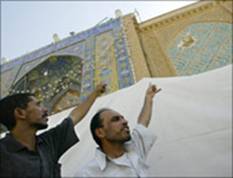
Iran denies support for Sadr as shrine hit; Ayat Sistani visited By: Ismail Zabeeh HOLY CITY OF NAJAF, Iraq: Powerful explosions and gunfire shook Holy Najaf on Monday amid fierce battles between US forces and Moqtada As-Sadr’s Mehdi army militiamen around Imam Ali bin Abi Talib (peace be on him) shrine, which caused damage to the holy wall of the sacred shrine. Large plumes of thick, black smoke have been seen rising close to the holy shrine. According to reports mortars have been fired at the cemetery around the Shrine, a base of Sadr militia. Director of the Sadr office in Nasiriya Aws Al-Khafaji told Aljazeera the damage to the outer western wall of the holy shrine occurred during clashes between the occupation forces and the Al-Mehdi Army on Sunday night. Supporters of Sadr said US aircraft had fired a rocket into the wall, news agency AFP reported. The US military denied that the shrine had been targeted. “US forces responded to hostile fire, but the fire was not directed at the shrine. It did not hit the wall or any other holy site in the area,” a military spokesman said. An AFP correspondent said there was a dent in the wall measuring about 1 square meter and 30 centimeters deep, with rubble and spent parts of a rocket littered on the marble floor. Palestinian movement Islamic Jihad called upon Moqtada Sadr to sabotage Iraqi oil facilities. French news agency Agency France Press (AFP) obtained a copy of Islamic Jihad's statement that urges Sadr to hit the oil facilities because their income fills the coffers of the “occupation forces and their collaborators”. In another development, Iranian President Mohammad Khatami denied any “provocative interference” in Iraq and any support for Moqtada Sadr, the official news agency IRNA reported. He was talking to newsmen in the tomb of the late founder of the Islamic Republic Ayatullah Ruhollah Khomeini. He denied his country's involvement in the ongoing violence sweeping the holy city of Najaf in central Iraq. “We have never officially and openly supported any groups in Iraq,” he said when asked if Iran supports Moqtada Sadr, but asserted: “even groups whose oppression has been an excuse for these (US) operations (in Najaf) have not committed any provocative acts in this period.” Khatami said there had been no specific contact with the United States over events in Najaf. Pointing to the recent US attacks on Sadr's militia in Najaf he said: “It is obviously an attempt to intimidate the entire Iraqi nation and to create an atmosphere in which they can impose their will on the fate of the government.” On August 10, US State Department deputy spokesman Adam Ereli said the United States was concerned by suggestions that Iran is involved in deadly unrest in the holy city of Najaf and maintained it was not in Tehran's interest to foment instability in its neighbor. Meanwhile, a representative top-level delegation of Iraq's interim government visited Ayatullah Ali As-Sistani on Sunday afternoon in London where he is recovering after medical treatment, a statement said. The delegation met the cleric to express its respects and “deep appreciation for his on-going role for peace and security in Iraq,” it said. “We very much hope that he will return safely to Iraq when his doctors allow, considering his presence there is important for our entire nation,” said senior official Zuhair Abdul Ghani Humadi from the council of ministers secretariat. END |
| ||||||||||||||||||||