|
| ||||||||||||||||||||||

 | ||||||||||||||||||||||
| February 20, 2004 | | ADVERTISE | ABOUT US | FEEDBACK | | |||||||||||||||||||||
|
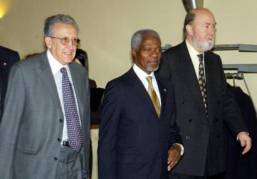
UN chief says Iraq can't vote before June 30 By: Nabil Raza UNITED NATIONS: UN Secretary-General Kofi Annan backed the US position Thursday and recommended against holding elections in Iraq before the June 30 transfer of power to Iraqis. He made no recommendation on how to form a transitional government. Annan and his special adviser, Lakhdar Brahimi, spoke to reporters after a 90-minute meeting with representatives of 45 nations and the European Union where Brahimi gave a briefing on his weeklong visit to Iraq. “We shared with them our sense, and the emerging consensus, or understanding that elections cannot be held before the end of June, that the June 30 date for the hand-over of sovereignty must be respected, and that we need to find a mechanism to create a caretaker government and then prepare the elections later, sometime later in the future,” Annan said. Earlier, US overseer Paul Bremer said Thursday the formula for establishing a new Iraqi government could be changed but the date for the US-led coalition to hand over power remains firm as a Shiite official said after talks with Ayatullah As-Sistani that it was acceptable to delay elections by up to three months beyond the power transfer. “Changes are possible but the date holds,” Bremer told reporters, adding that there were “dozens” of methods for selecting a new government. Among the options, he said, were a redesigned “caucus” system or partial elections. Talking to newsmen following his meeting with Ayatullah Ali As-Sistani in the holy city of Najaf, Ahmed Shaker al-Barrak, a member of the US-appointed Governing Council said: “There is no problem for any transitional body to assume power and prepare for elections on condition that it will be held before October 1, 2004.” Meanwhile, a gathering of thousands of clerics and tribal elders held a meeting in the Iraqi capital Baghdad on Thursday. They called for unity among Sunni and Shiite Muslims and discussed the future of Iraqi governance. END |
| ||||||||||||||||||||