|
Najaf becoming Iraq future after deliberate politics to destroy it
By: Ismail Zabeeh
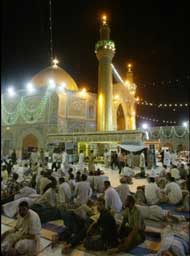 |
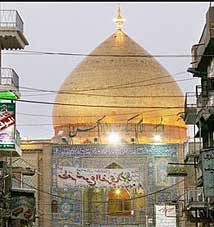
HOLY NAJAF, Iraq: Investors are flooding into the holy
city of Najaf - a relative oasis of peace in Iraq - hoping to profit
from the millions of religious pilgrims who come to visit the holy
shrine of Imam Ali Ibn Talib (peace be upon him).
While the city lacks facilities to reap the profits from these
visitors, that is about to change.
Over the last six months, private investors have been competing for
contracts to build the holy city into a grandiose destination, with
five-star hotels, transportation and recreation. The enthusiasm hints
at what might take place elsewhere in the country, were peace and
stability to prevail.
From an airport, to a complex of hotels, to a train between the holy
cities of Najaf and Karbala, Najaf's future is bright.
A $1 billion contract was signed with a Kuwaiti company, Fedek, to
create a railroad system between Karbala and Najaf. One investor,
Global Enterprise, plans to invest $125 million in a tourism complex
in Bahr -on Najaf, a desert area of beautiful stone cliffs and
palm-tree groves. The center will be a complex of resort hotels that
have their own water supplies and generate their own electricity,
Munthar Ajinah, who is in charge of investments under the governor of
Najaf, said. It will outdo the typical small, rundown local hotels
that have only one item on their restaurants' menus.
A stretch of desert north of the city, fenced in and guarded by police
officers, will be an airport for pilgrims to fly directly to Najaf. An
Iraqi British company, Fahad al Basra, signed a $72.8 million contract
to turn this desert area into an airport. A stretch of black pavement
cuts through the desert, a runway left from Saddam's military, and
will serve as a landing strip.
"This is the only thing we inherited from the past regime," said
Haider al-Ramahi, an assistant to the governor.
Lebanese and Iranian companies are interested in opening airlines that
will transport people to the airport, Ramahi said.
Companies plan to share an agreed percentage of the profits of each
project with the province, Ajinah said. Soon, Najaf will be the center
of Iraq.
Small hotels are popping up on the horizon of this city, a soccer
stadium was built with coalition money, and nearby in the town of Kufa,
about $250,000 in coalition money paid for the renovation of a
restaurant and walkway, complete with spouting fountains and colored
lights, along a branch of the Euphrates River.
Recently, Boeing approached the governor about using an old military
airport from Saddam’s regime, a drive of several hours away near the
Saudi border, to build a workshop that would serve as a Middle East
destination to repair planes, Ramahi said.
Basic reconstruction is visible as men cement bricks
into the sidewalks. The work cannot keep up with demand, said Haider
al-Mayali, a local official in charge of reconstruction and
development.
In part, reconstruction owes its success to the relative security of
the city, Mayali said. Coalition forces now hang in the background
since the handover of the city four months ago. They are seen only at
openings of new facilities built with coalition money, at their base,
or in the small office they have in the governorate building.
Decisions about where money will be spent are left up to local
officials, who give coalition forces a prioritized list.
But this is only a start, Mayali said. "It was deliberate politics of
the past regime to destroy this city," he said.
Now Najaf is picking itself up and striving to become the future of
Iraq.
Ajinah has bold plans for Najaf, including a mall to replace an old
marketplace downtown, a spa resort, and an amusement park.
"I'm 68. When I'm 78, I want everyone to call Najaf the pearl of the
Middle East," Ajinah said.
 |
|
Husseini shrine magnetizes millions on Arafah Day
|
|
|
|
HOLY CITY OF KARBALA, Iraq: Several million devotees visited the holy mausoleum of Chief of Martyrs Al-Imam Abi Abdellah Al-Hussein (peace of Allah be on him) marking the Day of Arafah, the Zul-hijja 9, amid tight security measures.
|
|
|
|
|
|
 |
| |
"Knowledge is
better than wealth because it protects you while you have to
guard wealth. it decreases if you keep on spending it but the
more you make use of knowledge ,the more it increases . what you
get through wealth disappears as soon as wealth disappears but
what you achieve through knowledge will remain even after you."MORE
..

|
|
|
|
|
|
|