|
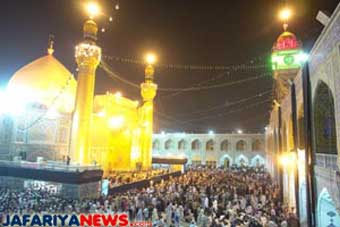
City of Imam Ali (AS) witnessing a boom
By: Ismail Zabeeh
HOLY NAJAF, Iraq: Holy city of Najaf's first airport is weeks away
from opening, but already a bigger one is talked about. Land prices
are soaring. Merchants say they don't remember business ever being so
good.
Today, the holy city is a hot spot of a different kind thanks to
improved security, a free-for-all market economy — and a direct
pipeline to the government.
The boomtown buzz in Najaf is more remarkable for its limited company.
It's matched only in the northern cities of Sulaimaniyah and Irbil in
the self-ruled Kurdish region in northern Iraq, which has been mostly
a bystander in the war.
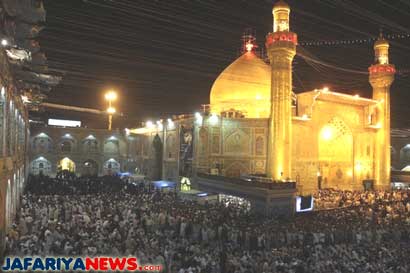
The city's ancient bazaar stays open until around 11 p.m., quite
late for a market in most parts of Iraq these days due to security
concerns. Shoppers fill narrow alleys to buy gold and silver jewelry,
spices, worry beads and perfumes sold in small ornate bottles.
Ahmed Redha, head of the state Investment Authority in Baghdad,
estimated that US$38.8 billion in projects are on the drawing board
for Najaf and many will be undertaken by private companies. The core
of the plans call for new luxury hotels and more than 200,000 housing
units, he said.
A dramatic improvement in security has persuaded more Iraqis — as well
as Shiites from abroad — to travel to Najaf.
Police patrols and checkpoints fill the city of about 1 million people
on the edge of Iraq's western desert, but local authorities say they
plan to greatly reduce the number of security forces on the streets by
installing security cameras around the Imam Ali shrine and other busy
parts of the city.
The locals are happy to see foreign visitors returning, particularly
big-spending Arabs from the Persian Gulf.
"Everyone is doing good business," gold jeweler Aitan Abdul-Hussein
said after he served two Iraqi women in black flowing abaya robes in
his tiny shop. "I sell a kilogram of gold every day. That used to be
my monthly average a year ago."
The $55 million airport on the southeastern edge of the city is giving
everyone hope that even better days are ahead. A ceremonial opening
took place in July and the anticipation of commercial flights has
pushed land prices up by as much as 60 percent, according to the
airport's manager Karim al-Abdali.
Tour operator Ali Abdul-Hussein says most of the 11,000 Shiites he has
brought to Najaf over the past two months flew to the southern city of
Basra and traveled north by bus. Most came from Gulf nations as well
as Iran, India and Pakistan.
"The airport will help our work," said Abdul-Hussein as a Bangladeshi
worker dusted air conditioners in the marble-and-glass lobby of
Najaf's newest hotel, Qasr al-Dur.
Al-Abdali said the airport's expansion potential was limited because
developed areas were too close. One proposal is building a separate
airport just for international flights. He did not have a timeline.
Najaf residents appear happy over the jobs and money that have flowed
into their city. But some complain that local authorities have much to
learn.
For example, no-bid contracts are awarded to local companies with
little expertise or resources, while foreign companies remain
reluctant to come to Iraq, fearing for the safety of their workers.
"We are still very new in this," said al-Abdali, the airport's
director. "In our rush to develop the country we are making mistakes."
The rush to modernize the city is also bringing worries about blows to
Najaf's character as the world's oldest seat of Shiite learning and
home to the sect's top clerics.
"We stand for preservation and modernization going hand in hand," said
Hassan al-Hakim, who lectures on Islamic history in the nearby Kufa
university and heads a local foundation to protect the city's
heritage.
Sheik Ali Bashir al-Najafi, son and top aide of one of Najaf's four
top clerics, says the powerful religious Shiite establishment in the
city has its own vision for development in Najaf.
"We support the development of the city in the best possible way," he
said. "But we want the work done in a way that respects the spirit of
a city that hosts Imam Ali."
Hazem al-Haidari, a key member of Najaf's provincial council, sought
to allay fears over the loss of the city's identity.
He said plans under consideration for the old quarter would strive to
create a balance between modernity and history. "There will be no
giving up of the old town's heritage and landmarks," he said.
But he noted that parts of the old cemetery may have to be removed to
make way for new roads.
|
|
 |
| |
"Knowledge is
better than wealth because it protects you while you have to
guard wealth. it decreases if you keep on spending it but the
more you make use of knowledge ,the more it increases . what you
get through wealth disappears as soon as wealth disappears but
what you achieve through knowledge will remain even after you."MORE
..

|
|
|
|
|
|
|