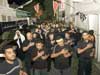
HOLY CITY OF KARBALA, Iraq: Ashura - the darkest day
of universal history – which marks the gruesome tragedy of Karbala in
which the grandson of Prophet Muhammad (p) Hussein bin Ali (p) along
with his 72 devoting companions was slaughtered unjustly some 1,400
years ago, was observed across the globe on Thursday February 9 with
main commemoration held in the holy city of Karbala – place of tragedy
– where an estimated four million mourners massed. The holy Karbala
was shrouded in black.

The millions of mourners marched and beat themselves in blood-soaked
processions through the holy city amid tight security.
A fierce sand storm swept the country on Ashura, the 10th day of
Muharram in the Islamic lunar calendar.


About 30,000 men wearing white shrouds and waving swords above their
heads began marching from 2 a.m. between the gold-domed Imam Hussein
(p) shrine and his brother, Abbas, about a kilometer away.
Following dawn prayers, thousands of people, including children aged
as young as eight, dressed in black as a sign of mourning and marched
between the two shrines to the beat of deep bass drums.
Some slapped chains across their backs until their clothes were soaked
with blood, while others beat their heads with the flat side of swords
and knives until blood ran freely to signify their grief on the
martyrdom of Imam Hussein (p).
"Although it is a sad day, I am very happy because I took part in
these head-beating processions," said 10-year-old school boy Haider
Abbas Salim, whose face was covered in blood. "Imam Hussein's
martyrdom teaches us manhood and that we shouldn't fear anything."


Pools of fresh blood covered the road through Karbala on which
mourners paid homage to Imam Hussein (p). The scene was repeated in
other locations across the country, including in Kazimiyah.
Some pilgrims walked for days to Karbala, 110 km (68 miles) southwest
of Baghdad.
"I walked for two days from Najaf to attend Ashura in Karbala," said
Jawad Kathum, 45.
Pilgrims from other countries, including India, traveled to Karbala to
attend the ceremony.
Many Iraqis cooked throughout the night and pilgrims attending the
ceremonies are given meals of rice and thick soup laden with meat and
chick peas.

Under Saddam, mourners were restricted from performing Ashura-related
rituals, such as processions of men beating themselves with their
hands, chains and the flat edges of swords in shows of grief.
More than 8,000 security forces and extra militiamen were deployed in
Karbala preventing vehicles from entering the city. The United States
has been using unmanned and unarmed drones to provide an aerial view
of processions. Karbala was sealed off to vehicles and checkpoints
were set up to body-search pilgrims arriving from other cities.
Large numbers of police were positioned around Karbala's water
treatment plants.
"We are securing these facilities from being poisoned by terrorists,"
said policeman Ali Ameen.
In Saudi eastern city of Al-Qatif, several thousand Saudi mourners
took to the streets to mourn the martyrdom of Imam Hussein (p).
Participants said the mourning ceremonies were the biggest in the
kingdom where Shias are slowly testing government pledges to let them
practice their religious rites more freely.
Within the confines of towns and villages in the Eastern Province,
youths dressed in black beat their heads and chests to echo the
suffering of Imam Hussein (p) and mark Ashura.
''O Hussein, you have been wronged!'' said banners, referring to the
killing of Imam Hussein (p) 1,400 years ago in Karbala.
Imam Hussein (p) kissed martyrdom to defend Islam and Shari’ah and
save high human values writing the best example of presenting
sacrifice in love for Allah.
In India, Hindus also take part in Moharram mourning with devotion. As
many as 100 Tazias are prepared and taken out in processions by Hindus
in Bhopal city. Besides, hundreds of them also have a Darshan of
Tazias.
In Syria, tens of thousands of mourners took to the streets of Sayyida
Zeinab (p) shrine, south of Damascus, in the early hours of Thursday
and cut the tops of their heads to show grief over the tragedy of
Karbala.
Here is a photographic report of Ashura from some
countries: